

A few days ago, a dear friend of mine sent me a WhatsApp message with a link and the words “The never-ending story!”
The headline on the link was to a story in the Fort Lauderdale Sun-Sentinel:
Trump pardons key figure in fraud that led to murder of Miami Subs founder
I didn’t know whether to laugh or cry. Not because the pardon surprised me — very little surprises me these days — but because I spent the better part of a year reading everything I could about that murder. Seeing the name again was like hearing a boat you used to know hailed on channel 16, twenty years after you last saw her.
As many of you already know, the bitter end is the absolute last link of anchor chain or section of rope before the line runs out completely. It’s the end you hope never to see, because if you’ve paid out every foot of rode and the anchor still hasn’t found bottom, you might be in real trouble. That’s where the expression comes from. Not bitterness. Just the end of the rope.
Bitter End is also the title of a novel I published in 2005 based on the murder of that very same Miami Subs founder — Gus Boulis. I had no idea how well that title would age.
The man who jumped ship
Konstantinos (Gus) Boulis was a fisherman’s son from Kavala, in northern Greece, who used to run down to the shore every afternoon to wait for his father’s boat to come in. At nineteen he shipped out and jumped ship in Halifax. He washed dishes at a sandwich shop in Toronto, and if the story ended there it would be an ordinary one.
Instead, he saved every penny, bought that sandwich shop company, and turned it into a couple hundred stores. Then he sold out, moved to Florida, and built Miami Subs — which would eventually expand to 150 franchise locations in sixteen states, along with Puerto Rico, Peru, the Dominican Republic, and Ecuador. If you lived in South Florida in the eighties and nineties, you know you could not drive four blocks without passing one of those pink flamingo cups and turquoise-colored joints. The success of Miami Subs made Boulis a multimillionaire. Remember the curly fries?
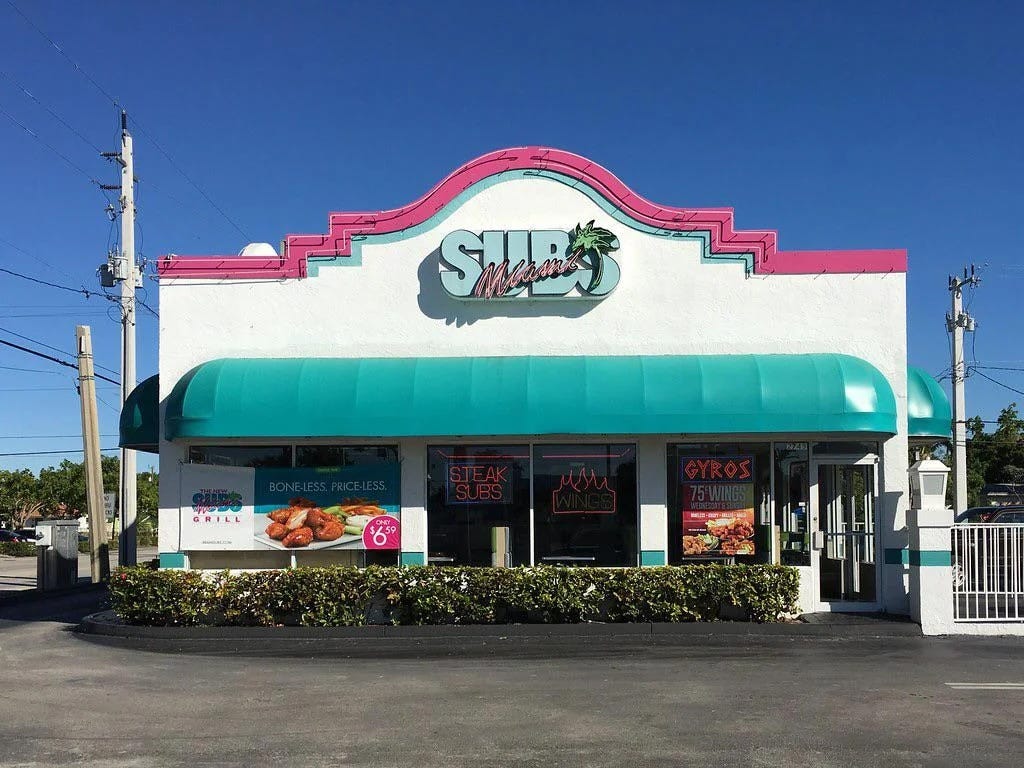
Gus was known in South Florida, especially in the Greek community, for his big personality. In 1994, he took three hundred of his Miami Subs employees out on a gambling boat for a company party. Days later, he bought his own hundred-footer and converted her into a floating casino. At the time, casino gambling in Florida was illegal, but go three miles offshore on the Atlantic side and all bets, slots and card games were on. Gus was always a guy who saw an opportunity and went for it. Eventually, he’d sell Miami Subs to Nathan’s Famous in 1999 and go all in on the floating casino business.
He called the fleet SunCruz Casinos. Eleven ships. Two thousand employees. “Cruises to nowhere” — run offshore into international waters where Florida gambling law couldn’t reach, let everybody play blackjack until the small hours, bring them home. He had boats going out of Dania, Miami, Tampa, Jacksonville. On the Gulf side the boats had to steam nine miles to reach legal water instead of three, which made for a considerably longer evening.
Perfectly legal, and enormously profitable, but the port cities where the ships docked weren’t exactly fans as the drunk and unruly gamblers poured off the boats in the wee hours. There were complaints.
Not American enough to own a boat
Florida spent years trying to shut him down and mostly failed. In 1998, the Broward sheriff and the state attorney general raided one of his boats and seized three hundred slot machines and $630,000 in cash. Boulis beat them in court and got it all back.
But it made headlines, and attracted the wrong attention. The state couldn’t touch him, but the federal government could — and it did it with maritime law.
There is a century-old tangle of protectionist American shipping statutes — the same body of law that gave us the Jones Act — and one of its oldest provisions says foreign nationals may not own U.S.-flagged commercial vessels. Although Boulis became a naturalized citizen, at the time he bought the boats and started the business, he was a Greek citizen.
That’s the pivot this whole tragedy turns on. Nobody ever accused Gus Boulis of cheating a single customer. They accused him of not being American enough to own the boats.
In early 2000 he settled: paid a fine, agreed to divest himself of SunCruz entirely, and get out of the gaming business. The government agreed to keep the settlement confidential so he could still get a fair price. In January 2000, Gus Boulis went looking for a buyer.
This next part gets complicated, and it falls under the “You can’t make this shit up” or “only in Florida” category. If you’ve seen the Kevin Spacey movie Casino Jack, some of this might even sound familiar
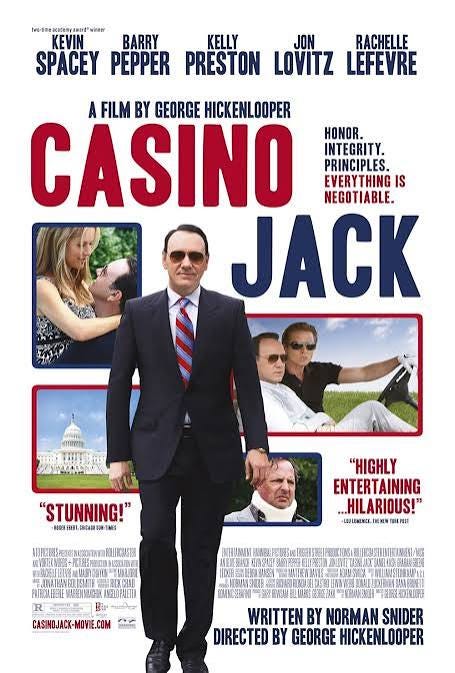
Gus’s own lawyer worked at a big Seattle firm, and it just so happened that a lobbyist named Jack Abramoff worked for the same firm. It was there Abramoff heard that SunCruz was for sale under duress. Abramoff had built his name lobbying for tribal casinos — and within a year he would be running the largest Indian casino fraud in American history, taking six tribes for something like $85 million. He knew exactly what kind of money casinos produced. So he told the lawyer he knew some interested buyers.
He neglected to mention that the interested party was him.
The little problem that he didn’t have the money was not going to stop him.
Abramoff brought in Adam Kidan, a pal from their College Republican days, who owned a Dial-A-Mattress franchise. Abramoff thought Kidan might have the money. The price was $147.5 million. The lenders required the buyers to put up $23 million of their own money first.
Kidan turned out to be as broke as Abramoff. So they produced a wire transfer confirmation — the old photocopy-and-white-out trick — showing they’d paid it. On the strength of that forged paper, and Abramoff, who was a hell of a bluffer, the lenders handed over about $60 million, and the deal closed in September 2000.
The ink was barely dry on the sales contract when Abramoff and Kidan took over the business and both sides started accusing the other. The new owners put themselves on the payroll to the tune of $300,000 a year and started using the business as their piggybank. Worse yet, they fired staff, many of whom were Gus’s friends and family. Kidan accused Boulis of having removed slot machines from some of the boats they had bought, which were no longer his property.
When payments didn’t go through and the lender started asking questions too, Boulis accused the buyers of fraud and said the deal was off. He wanted his boats back.
There were shouting matches, and in early December 2000 an apparent fistfight in the Dania Beach office, where Kidan accused Boulis of attacking him and stabbing him in the neck with a ballpoint pen. A witness told police it was Kidan who provoked it, by insulting one of Boulis’s employees. Either way, Kidan claimed he then feared for his life. So he hired some muscle.
A “business consultant” named Anthony “Big Tony” Moscatiello, previously indicted as bookkeeper for the Gambino crime family, went on the books as a catering consultant to the tune of $145,000. A second consultant, Anthony “Little Tony” Ferrari, was pulling $95,000 for security, plus a side of casino chips.
Two wiseguys named Tony? If I’d put that in a book, I’d have been laughed out of my editor’s office.
Later in court, Kidan swore he thought having those guys around would just keep Boulis from coming after him — he claimed he’d never imagined they would hear the boss’s complaints and take matters into their own hands. Yeah, sure.
By then the partnership had gone completely to hell. Boulis sued in January, claiming they were cheating him out of tens of millions.
What happened on Miami Road
On the night of February 6, 2001, Gus Boulis left his Fort Lauderdale office around 9:30 and turned down Miami Road. A car pulled in front of him and stopped. A black Mustang came up alongside. Somebody in the back seat opened fire.
Shot, Boulis still got his BMW out onto Federal Highway before it crossed the median and came to rest against a tree — outside a Burger King, directly across the street from a Miami Subs. He died a short while later. He was fifty-one.
What I did with it

In late 2003, I needed a new idea for the third book in my series about Seychelle Sullivan, the captain of the tugboat GORDA on the New River in Fort Lauderdale. the Gus Boulis story had been hogging the headlines and my imagination was fired up. All my books have titles that have multiple meanings, and Bitter End was published in 2005.
My gambling-boat tycoon character is Nick Pontus, and I placed him at the flybridge helm of his yacht, running up the New River, passing under the Andrews Avenue bridge. The shooter stops his black Mustang up on the bridge. Shots ring out, Nick falls, shoving the throttle forward, and the yacht careens away, scraping through the raised railroad bridge before smashing onto the rocks in front of the old River House restaurant (formerly The Chart House). Seychelle Sullivan, headed up river too, watches the whole thing happen from the helm of her tug.
Then I gave Nick a teenage son — a scared, grieving kid who inherits a floating gambling enterprise along with a killer who sets his sights on him next — and I gave Seychelle the job of keeping him alive.
In every book in the series, Seychelle is more about protecting the innocent than finding the guilty, but you can’t do the one without the other.
Bitter End came out in September 2005. That same year, the real case finally cracked. Abramoff and Kidan were indicted for the fraud in August — and on the very day my book released, the police arrested Big Tony, Little Tony, and James “Pudgy” Fiorillo, whose black Mustang turned out to be the car used in the hit.
I had published my ending, the one where the guilty got theirs. Reality took a good deal longer, and did a much worse job.
Aristotle and Alexander
Gus Boulis had two sons, Aristotle and Alexander. They were small boys when their father was shot.
When Kidan and Abramoff were sentenced for fraud in 2006, the court ordered them to pay $21.7 million in restitution to the people they had defrauded. Those boys were among them. Kidan served thirty-one months of a seventy-month sentence and was out in 2009. There is no indication in his court file that he ever paid the sons a dollar.
He did quite well afterward. He built a staffing company. He became a substantial Republican donor, giving well over a million dollars. In February 2023 he was married to his much younger Brazilian bride at Mar-a-Lago, about two hundred and fifty guests, the President and First Lady in attendance, Andrea Bocelli singing.
On July 3rd of this year, in a batch of eleven pardons released the Friday before the big 250th birthday celebration on the Fourth of July, President Trump pardoned Adam Kidan. A day or two later, I got that WhatsApp message.
Indeed, it is the never-ending story. At first, I couldn’t figure out why a guy long out of jail would care about that old case. The pardon can’t give him back the thirty-one months. But then I realized what it does buy him. Not only does the pardon erase his felony — it dissolves the $21.7 million, plus twenty years of accrued interest, owed to his victims. Including the two boys, now grown men, who lost their father on Miami Road.
Seychelle would not be happy about that.
The end of the rope
Here is where twenty-five years of creeping through the courts got us.
The actual gunman was killed in 2003 in an argument with a deli owner, so he was never charged with anything. Pudgy served about six years and testified against the Tonys. They both had their murder convictions overturned on appeal, pled down to second-degree, and have been free men since 2022. Adam Kidan, the man who hired and paid them, was never charged in the murder case at all — he testified for the prosecution — served under three years for the fraud, and last month had the rest of it wiped clean.
Nobody is in prison today for the murder of Gus Boulis, and his sons will never see the $21.7 million a federal court said they were owed by the men who defrauded their hard-working Greek father.
A bitter end indeed.
See, that’s why I like writing fiction. In my stories, the bad guys don’t get away with it.
Fair winds!
Christine
If you’d like to read the novel I made out of all this, just click the book cover below.

even in summary, your writing raises the hair on my arms. I was a MiamiSubs eater: pickles on my chicken philly. Great way to start the Monday, week, and month!
Great post. I have got to check out that book!