

This morning we stood in the drizzle in a Belgian village and watched a parade go past.
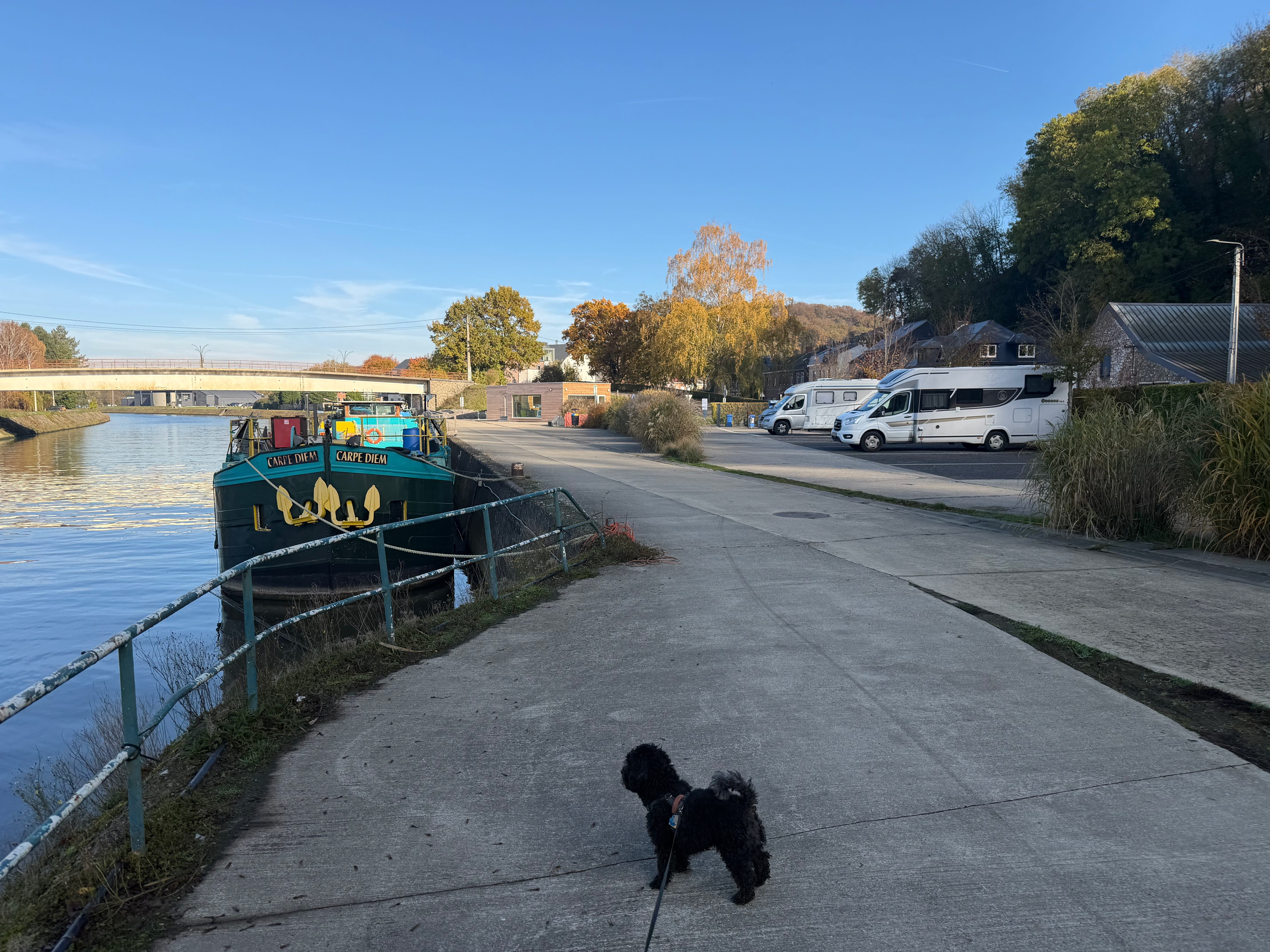
Floreffe sits on the Sambre River, about halfway between Charleroi and Namur. Wayne and I are parked here at the river’s edge in a rented caravan with the pups, Razz and Zoë.
Yesterday’s sun was gone, but the village turned out — men in the blue coats and red trousers of 1914, others in uniforms from wars I couldn’t place, Boy and Girl Scouts, teenagers in jeans and jackets carrying the black, yellow and red flags and walking at the same slow pace as the old men ahead of them. We’d been listening to the drumbeats and the melody of the piper as they approached. Nobody waved.
They stopped along the river embankment just past our parking spot. As the church bells tolled the eleventh hour, the crowd stood still, their heads bowed. I heard the ducks on the river in the silence that followed the bells, then kaboom — the old rifles went off in a puff of smoke.
When the smoke cleared, the drum roll started anew and the whole thing took about four minutes to pass back into town. Then the street was empty again.
In the States we call today Veterans Day. Here in Belgium, and in Britain, Canada and across the Commonwealth, it’s Remembrance Day. Same date, and the date is the point.
At eleven o’clock in the morning on the eleventh day of the eleventh month of 1918, the guns on the Western Front stopped. The Armistice had been signed hours earlier, before dawn, but it was set to take effect at eleven — and so men went on fighting and dying through a morning when everyone with a watch already knew the exact minute the war would end.
That’s the hour we’re all marking, over a hundred years later.
This river valley suffered in those years. The fighting along the Sambre came early, in the first weeks of the war. I walked the dogs over to examine the place where the parade had stopped, and there was a stone cross. A placard next to it told the story of a 19-year-old boy, not a soldier, who was the first to meet the advancing Germans there at the edge of the village. They asked him if there were French soldiers in the town. He lied, telling them no. They shot him on the spot.
For the people here, the war wasn’t four years of news from the front. It was four years of occupation — soldiers in the houses, food requisitioned, a river and a rail line that made their village a valuable supply depot.
I guess that’s why a village this size still turns out in the rain.
My maternal grandfather drove an ambulance in that war. He was wounded, and he came home with what they called shell shock back then. He had it for the rest of his life, and he struggled to support his family when he returned. I never met him. He took his own life before I was born. But I grew up with a mother who had been shaped by a war that ended before she was born — and decades before I turned up.
I didn’t care about any of this as a kid. History was a subject I had to get through. It’s only as I’ve gotten older that my lack of interest has evolved into fascination. I have so many questions I would like to ask now of my family members who are gone.
People always ask writers, “Where do you get your ideas?” For me, I get curious to know something more. The Shipwreck Adventure series started when I got curious about the Surcouf, an outrageous French submarine that vanished in 1942 and has never been found. The Internet is still full of conspiracy theories about what happened to her. Little did I know at the time that I would get some kind of submarine fever and write a trilogy about three different subs.
And then came Whiskey Creek — my first book set entirely in the war — and, of course, there are U-boats. Annie Jeeves is a Florida girl who’s good with charts, and like when I was her age, she wants nothing to do with it all. But the war finds her anyway.
Today on this November 11, join me in honoring our veterans, lest we forget.
And a bit of news
I’m reissuing the three books in the Shipwreck Adventure series in new editions since these books were formerly exclusive to Amazon. Now they are available on all platforms, so anyone who hasn’t read them already can buy them by clicking on the title links below.
I’m experimenting with a new book retailer called CURIOS. If you buy the books from them, you can still get the ebook on the reader of your choice or buy a paperback, but you will be supporting my work as they offer authors a bigger piece of the pie.
Dragon’s Triangle, the second book in the Shipwreck Adventure series, came out yesterday. Riley follows a letter from a ninety-three-year-old stranger to a lost submarine and a legend of stolen gold.
Circle of Bones, where the series starts, is on sale at $2.99 at the moment.
Knight’s Cross finishes the trilogy on December 8, and the ebook is up for pre-order now.
Fair winds,
Christine
Christine, I continue to read and enjoy everything you write. In a few months, it will be 70 years since I was walking the streets in Bruges and Namur and I noticed in your photographs that very little has changed. Keep up the good work. Pat Moss