


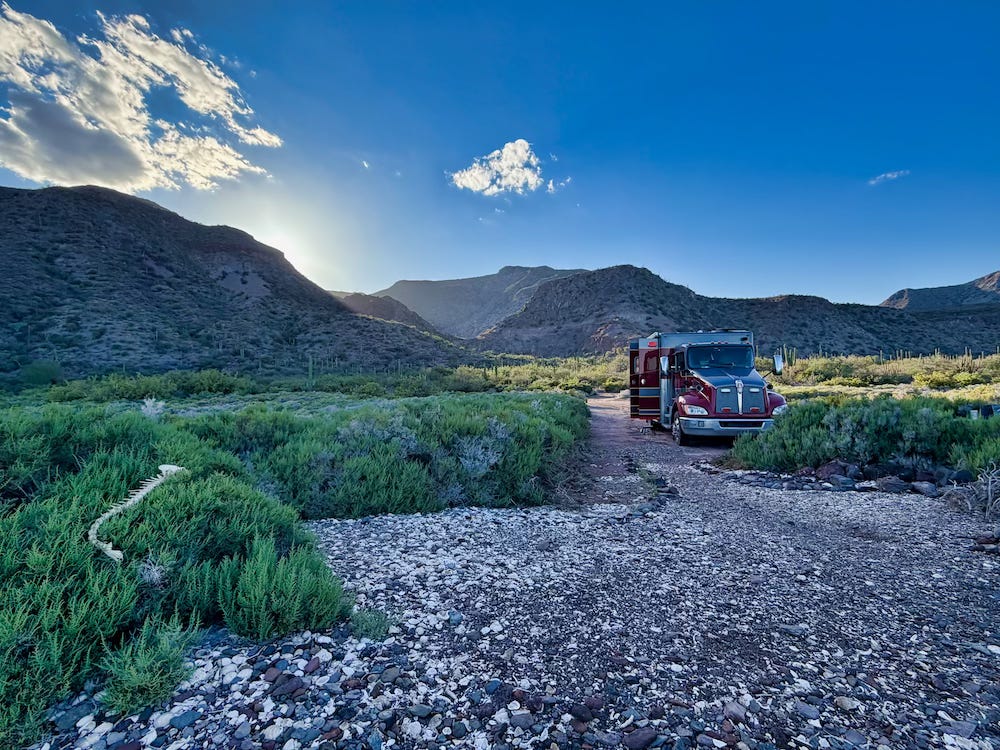
We’re packing up Lance, the campulance, tomorrow after two months of roaming Baja’s wilds. Camps at the water’s edge, Dr. Seuss boojums, and whales who eye you right back. It’s left me feeling like Alice in Wonderland: ‘Curiouser and curiouser…’ And now, very sad to wave goodbye.


For me, this trip has been a homecoming of sorts. The last time I traveled the roads south of Ensenada was in 1974 when at age 19 I decided to ride my bicycle from Tijuana to La Paz down the newly paved highway. What an adventure, seeing the crazy Dr. Seuss like cactus called boojums, fixing my many broken spokes, and pitching my little tent in the yards of family-owned ranches. That was over 50 years ago, and I’ve made it a life habit of going places my mother wasn’t thrilled about me going. Sorry, Mom. I wish you’d lived long enough to meet Wayne and see Möbius and Lance. I know, Lance isn’t a sailboat, but really, it’s just a different-shaped hull. And on this trip when we’re camped right at the water’s edge, we get to go to sleep listening to the surf.


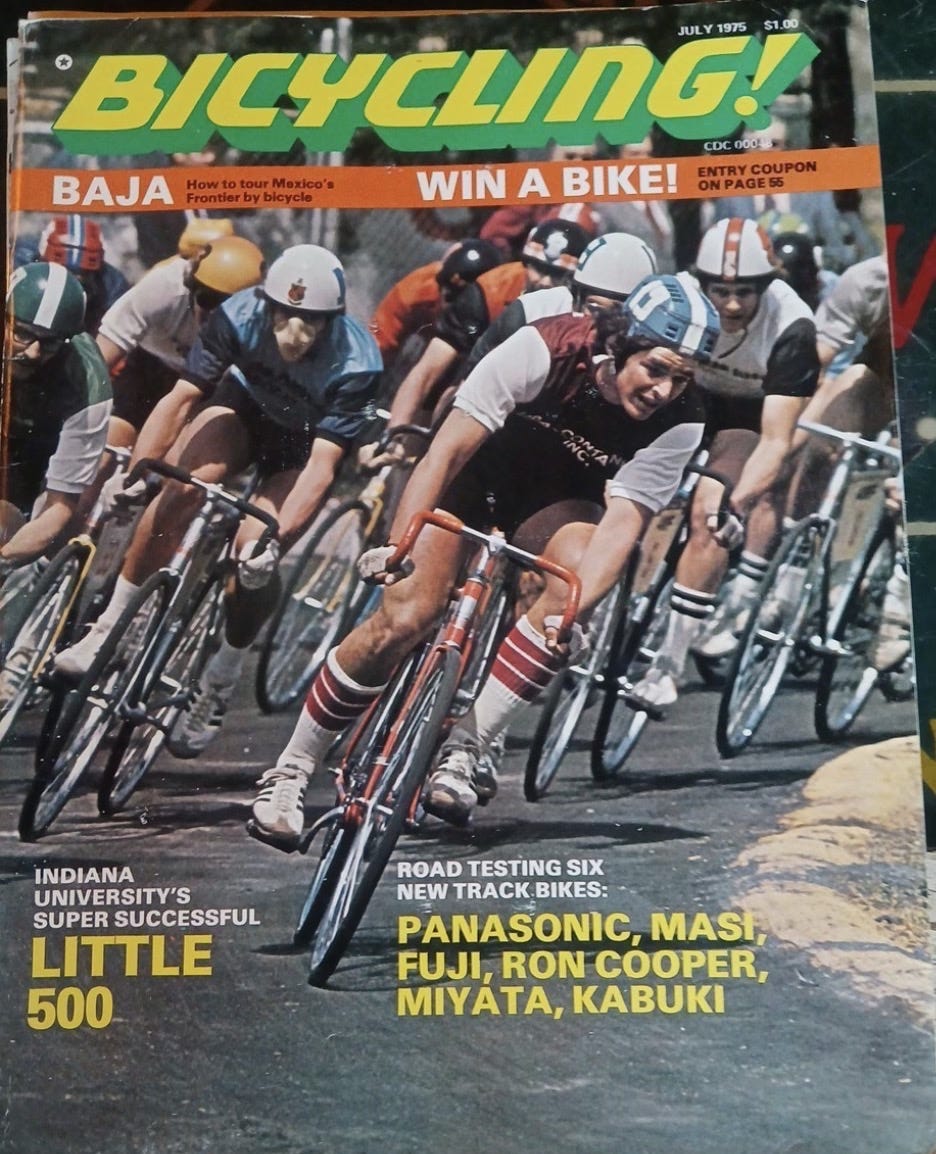
Back in the 70’s, I yearned to explore Baja, especially after reading John Steinbeck’s, The Log from the Sea of Cortez, as well as other books by Erle Stanley Gardner and Joseph Wood Krutch that fired up my curiosity. But I also wanted to launch my career as a writer. I had this crazy idea that you had to do something extraordinary and write about it in order to get published. It was crazy, but it worked and my very first publication was in Bicycling Magazine in July, 1975
I still love to do research, and even as my 72nd birthday approaches, my curiosity about the world has not dimmed. Frankly, I just don’t get the people who don’t love books and maps and travel. I am the one who does the research and navigating while Wayne does all the driving. Sometimes it wears on me, spending so much time pouring over apps like iOverlander, OnX Off-road, our paper Baja California Road and Recreation Atlas and Google Maps in satellite view, but it’s worth it when we find a great wild camp site all to ourselves.
Our dogs Zoë and Razz, the two Havapoo (yes, that is the unfortunate name for the Havanese/poodle mix) one-year-old siblings are the epitome of curiosity. They are loving the freedom of wild camping with new beaches to run down and discover all the new smells. Occasionally, when we go into a regular RV park to get rid of trash, wash clothes or fill up with water, they have to be leashed, which makes them very indignant. They are convinced they are wild little desert rats whose job it is to keep all seagulls and pelicans off their beach.


The first time we spotted whales in Baja was when we were down wild camping on the East Cape just north of Cabo Pulmo. We sat in our chairs having our usual sundowner glasses of wine when we saw the spouts offshore.
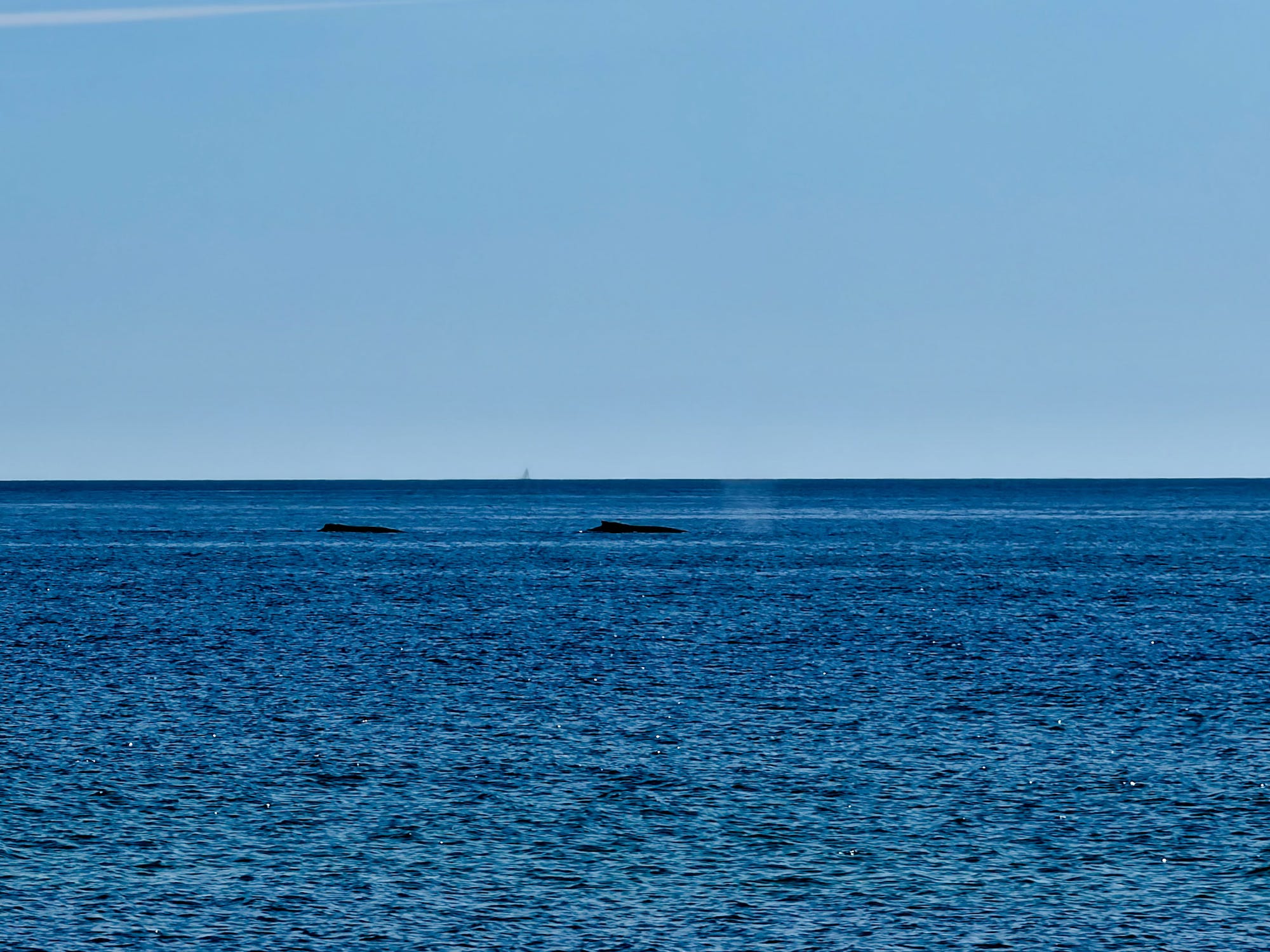
But that was just the beginning. From there, we went down through Cabo only stopping for groceries at Costco, and then on up the Pacific side of the peninsula to Los Cerritos Beach. All along the drive, I was seeing the whale spouts offshore. Los Cerritos Beach was lovely, and it was fun to watch the surfers, but as Wayne says, “A little too people-y for us.”


We never actually saw the whales in Puerto Chale, one of our next stops, but it was a very nice little fishing village that shifts into full on whale watch mode during the three months of whale season. The gray whales migrate over 5,000 miles from the Bering Sea to the lagoons of Baja California where the females give birth to their calves from January until March. Puerto Chale is on Magdalena Bay, a larger bay in the southern part of the peninsula.
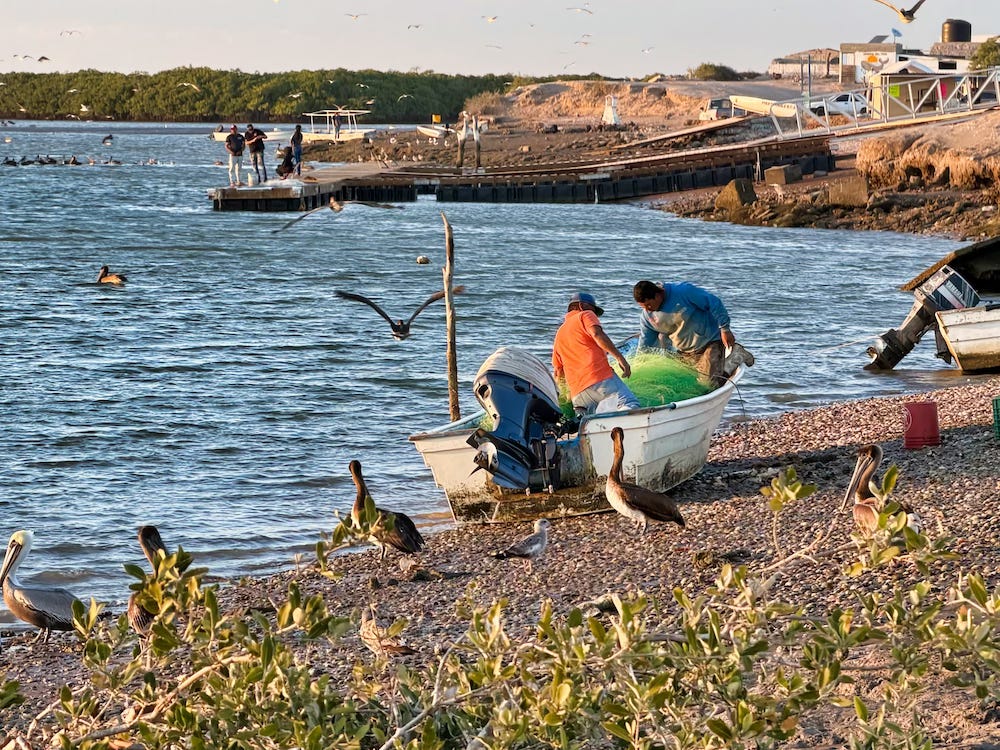
Every day we were in Puerto Chale, we saw the bus and van loads of tourists coming on the 2-hour trip from La Paz to go out to see the whales. It’s an amazing story about how these whales were hunted to the brink of extinction in the 19th and 20th century because they were so easy to kill in these shallow lagoons where they come to breed. But in 1947, they passed laws to protect them and changed the local economy to eco-tourism. The creation of breeding sanctuaries, particularly in the Ojo de Liebre Lagoon (formerly known as Scammons Lagoon), provided safe environments for calves.
Wayne and I now only give one another experiences as gifts (who needs more stuff at our age?), and for Christmas, I had given him a Whale Watch trip out of Guerrero Negro. We got up at 6:30 am, had breakfast with our guide and then made a 45-minute van ride over bouncy dirt roads to an encampment where they launched the pangas into the Ojo de Liebre lagoon.
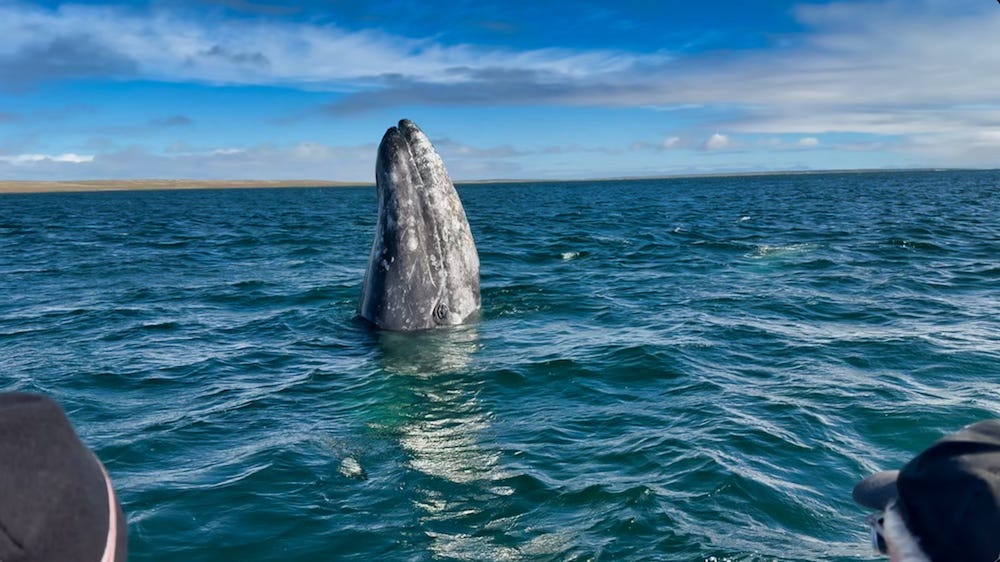
These animals that were hunted by humans only a few generations ago, are now just as curious as we are about them. In some ways, it felt like they had flipped the script on us. Usually we are watching wildlife, but in this case, it was clear they were watching us. We were stuck in these little boats, holding us like cages, and the whales were free to come and visit us, like we were their animals in the zoo. It’s impossible not to feel awe and wonder in their presence. On February 20, when we went out in that little panga at the height of the season, they estimated that there were over 500 whales in the lagoon. Here’s what it felt like.
These encounters don’t just satisfy curiosity—they ignite creativity. I made this video, and I hope to make more about our travels. And I’m certain I will be writing a book soon that will have whales in it.
We had made it to a campground about 70 miles south of San Felipe last weekend. We were sitting outside the truck enjoying our morning coffee while watching the seagulls dodge the incoming waves and the pelican armada skimmed the offshore swells in perfect flight formation. Suddenly, my phone started blowing up. Ding, ding, ding.
With the cartel violence in Mexico hitting the news, our friends and family were all checking in on us. Yes, we are fine. Very fine thanks. Our almost two months in Baja have been spectacular. We don’t scoff at danger or live recklessly, though some are flagging northern Baja as a dangerous place. I suspect that is only around the border crossings at Mexicali and Tijuana. We stayed at that little family-owned remote campground for more than the one night we had planned, but by Wednesday, we ventured into San Felipe and did laundry, had lunch (fish tacos!) and got supplies. The town was quiet, but we felt perfectly safe.
I am about to turn 72 on my upcoming birthday, and I know that many folks my age seek comfort over curiosity, but I reckon if those mother whales can bring their babies right up to the boats and then take off and swim 5,000 miles with them to summer in the Arctic, I can do a few more miles , too.
Besides, Wayne has been researching Overlanding vehicles in Africa. Who knows where we’re headed next?
Fair winds!
Christine
P.S. My latest book Whiskey Creek is now available on Amazon in ebook and paperback.

I have to admit never having been to Baja despite living in that part of the country for awhile. It definitely needs to go on the list! Love that you have your pups with you as well. We're trying to figure out how to comfortably bring our 140lb Newfy on the boat with us when we go cruising long-term. It's a process for sure!
Sounds like a wonderful trip! Keep on sailing down the road.